In recent years, with the booming development of the "culture and tourism+" market, outdoor unpowered amusement equipment has become the focus of the industry with an astonishing update speed. It not only breaks the inherent mode of traditional amusement, but also meets the integration needs of modern parent-child, cultural tourism, education and other fields. Its unique charm and value are increasingly recognized by more and more people.
1、 What is unpowered amusement equipment? Unpowered amusement equipment refers to active experiential devices that do not rely on non natural external forces such as electricity or mechanical power, but only rely on the user's own (such as human movement, gravity, etc.) to achieve amusement functions. The core of such devices lies in the "natural interaction between people and devices", which not only conforms to environmental protection concepts but also fully stimulates users' active participation, becoming the mainstream choice for outdoor amusement spaces today.
2、 Why are non powered amusement equipment so popular? 1. Accurately adapting to the growth needs of children and unleashing their natural instincts. Children have differentiated physical and mental development characteristics at different age groups, and non powered devices can accurately match this rule, allowing children of each age group to find exclusive fun: 1-3 years old (sensory exploration period): mainly using tactile, visual, and auditory stimuli, suitable for sand pits, clay areas, small swings, low slides, etc., helping children establish a preliminary understanding of the world; 3-6 years old (budding stage of social consciousness): Start playing in groups, enjoy role-playing and symbolic games, can be paired with themed slide combinations, small climbing frames, interactive tables and chairs, etc., to meet the needs of social and imaginative development; 6-8 years old (advanced stage of athletic ability): Pursuing flexibility and a sense of challenge, suitable for complex climbing nets, rope exploration areas, etc., allowing children to improve coordination while testing their physical limits; 8-10 years old (ability display period): Likes high difficulty challenges, can fully demonstrate body balance and coordination through advanced climbing facilities, obstacle crossing projects, etc., and stimulate adventurous spirit. 2. Safety and fun coexist, creating a peaceful amusement environment with color design that fits children's psychology: using bright color combinations such as red, orange, yellow, green, blue, purple, etc., breaking the monotony of traditional amusement parks, making it easier to attract children's attention and stimulate their interest in exploration; Comprehensive ground protection: Sand, injection molded rubber, rubber pads and other cushioning materials are commonly used to effectively reduce the risk of falling injuries, allowing parents and children to rest assured; Material safety and environmental protection: Choose safe materials such as wood, environmentally friendly plastics, and metals to avoid the release of harmful substances and ensure children's health. 3. Strong sense of experience, creating immersive amusement scenes. Non powered equipment focuses on "situational design", integrating devices into specific scenes through IP story implantation and creative styling (such as forest theme, ocean theme, fairy tale castle shape). Children are no longer simply playing, but exploring in an immersive way - for example, imagining climbing nets as "jungle adventures" and slides as "magical passages", fully stimulating imagination and creativity, making the play experience more three-dimensional and unforgettable.
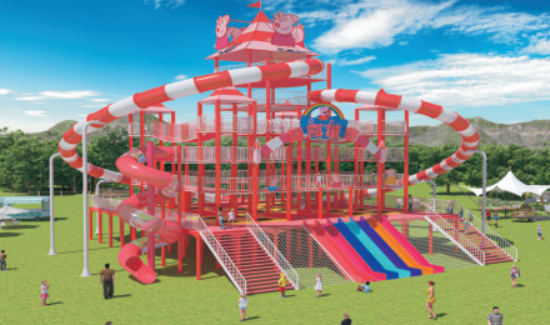
The unique charm of unpowered amusement facilities
Match products according to needs
Being active is a natural instinct of children, and exploration is an inevitable part of their growth. Outdoor passive amusement facilities fully unleash children's athletic nature, and according to their behavioral characteristics and psychological needs, different play products are fully considered for children at different stages of development.
Children aged 1-3 usually play alone and make some recognition in touch, vision, and hearing. This stage is suitable for playing with sand, clay, water, swings, and slides.
Children aged 3-6 begin to develop social awareness and play in groups, enjoying symbolic games, abstract toys, chairs, tables, slides, and mobile facilities.
Children aged 6-8 enjoy testing their flexibility on complex structures such as climbing nets that can elicit different motor responses. Children aged 8-10 enjoy showcasing their balance and coordination abilities on more complex climbing facilities.
4. Significant cost-effectiveness advantage, lower operating costs, and low procurement and operating costs: no need for electricity or mechanical power support, equipment procurement prices are lower than those of technology-based amusement facilities, and there is no need to bear high electricity and mechanical maintenance costs in the later stage; Simple maintenance: The structure is relatively simple, with a low failure rate. Daily maintenance mainly focuses on cleaning and inspecting connecting components, reducing operational difficulty and costs; Diversified value superposition: With functions such as amusement, sports, fun, and fitness, it can attract multiple types of customers such as parents, children, and teenagers, enhance the popularity and revenue of the venue, and become a "drainage tool" for scenic spots, rural areas, commercial complexes, and other formats. 5. Adapting to the integration of diverse business formats and becoming the new favorite of cultural tourism, passive amusement parks are gradually breaking through single amusement scenes and deeply integrating with education, rural areas, scenic spots, vacations, IP and other business formats, becoming the "glue" for the development of diversified business formats. Combining with scenic spots: creating themed passive amusement parks, enriching parent-child experiences in scenic spots, and extending tourists' stay time; Integration with rural areas: relying on the natural environment of rural areas, building wooden expansion parks and agricultural culture themed amusement areas to promote the development of rural tourism; Linking with education: integrating sensory integration training, natural cognition and other functions, becoming an outdoor education practice base; Combining with IP: Enhancing attractiveness and brand recognition through popular IP styling and story scene restoration.
The unique charm of unpowered amusement facilities
Match products according to needs
Being active is a natural instinct of children, and exploration is an inevitable part of their growth. Outdoor passive amusement facilities fully unleash children's athletic nature, and according to their behavioral characteristics and psychological needs, different play products are fully considered for children at different stages of development.
Children aged 1-3 usually play alone and make some recognition in touch, vision, and hearing. This stage is suitable for playing with sand, clay, water, swings, and slides.
Children aged 3-6 begin to develop social awareness and play in groups, enjoying symbolic games, abstract toys, chairs, tables, slides, and mobile facilities.
Children aged 6-8 enjoy testing their flexibility on complex structures such as climbing nets that can elicit different motor responses. Children aged 8-10 enjoy showcasing their balance and coordination abilities on more complex climbing facilities.
4. Significant cost-effectiveness advantage, lower operating costs, and low procurement and operating costs: no need for electricity or mechanical power support, equipment procurement prices are lower than those of technology-based amusement facilities, and there is no need to bear high electricity and mechanical maintenance costs in the later stage; Simple maintenance: The structure is relatively simple, with a low failure rate. Daily maintenance mainly focuses on cleaning and inspecting connecting components, reducing operational difficulty and costs; Diversified value superposition: With functions such as amusement, sports, fun, and fitness, it can attract multiple types of customers such as parents, children, and teenagers, enhance the popularity and revenue of the venue, and become a "drainage tool" for scenic spots, rural areas, commercial complexes, and other formats. 5. Adapting to the integration of diverse business formats and becoming the new favorite of cultural tourism, passive amusement parks are gradually breaking through single amusement scenes and deeply integrating with education, rural areas, scenic spots, vacations, IP and other business formats, becoming the "glue" for the development of diversified business formats. Combining with scenic spots: creating themed passive amusement parks, enriching parent-child experiences in scenic spots, and extending tourists' stay time; Integration with rural areas: relying on the natural environment of rural areas, building wooden expansion parks and agricultural culture themed amusement areas to promote the development of rural tourism; Linking with education: integrating sensory integration training, natural cognition and other functions, becoming an outdoor education practice base; Combining with IP: Enhancing attractiveness and brand recognition through popular IP styling and story scene restoration.




 冀公网安备13112102000693号 网站XML